
Wholesale Human Hair Wigs: Build a Buying Specification That Works
Wholesale Human Hair Wigs: Build a Buying Specification That Works

A wholesale wig order succeeds when the next parcel is as usable as the first sample. Soft hair is only one part of that outcome. Cap fit, color consistency, labeling, lead times, and a workable response to defects all affect whether the stock belongs in your business.
Before buying wholesale human hair wigs, write a specification that separates the fiber from the cap and the finished style. Then test a small order against that specification. This gives you a clearer basis for choosing a supplier than a long list of factories ranked without explaining the needs of the buyer.
Define the customer before the catalogue
Who will wear the pieces, and what service will you provide? A salon fitting individual clients needs different inventory from a fashion retailer selling a narrow range of ready-made styles. A custom wig maker buying components has a different requirement again.
Write down the customer's preferred length, expected styling routine, coverage needs, and tolerance for maintenance. Decide whether you need a full wig, a topper, or construction materials. Do not order a topper because its human hair description sounds attractive if your customers need full-head coverage.
The first order should answer a business question. You might be testing whether a specific bob shape fits your clientele or whether your consultation process can reliably match topper colors. An order spread thinly across unrelated categories can make the results harder to interpret.
Material and construction need different fields
The material field should state whether the item is human hair, synthetic, or a blend. Record any processing claims separately. The cap field should describe the relevant construction, size information, attachment features, and parting limitations. Keep the style, shade, and length in their own fields too.
If a supplier offers several constructions, ask for current photographs of the inside and outside of the actual model. “Natural-looking” is a result to assess, not a cap specification. Likewise, a human hair label does not tell you whether the front is lace or how the back will look in an updo.
| Order field | Write it clearly | Why it matters on arrival |
|---|---|---|
| Material | Human hair, synthetic, or stated blend | Prevents category substitutions |
| Coverage | Full wig or measured topper base | Connects stock to the customer's need |
| Color and style | Agreed shade reference and model | Makes comparison possible |
| Fit and attachments | Confirmed measurements and features | Reduces avoidable fitting problems |
| Care | Instructions for the exact fiber | Supports a realistic aftercare service |
A pilot order should expose practical problems
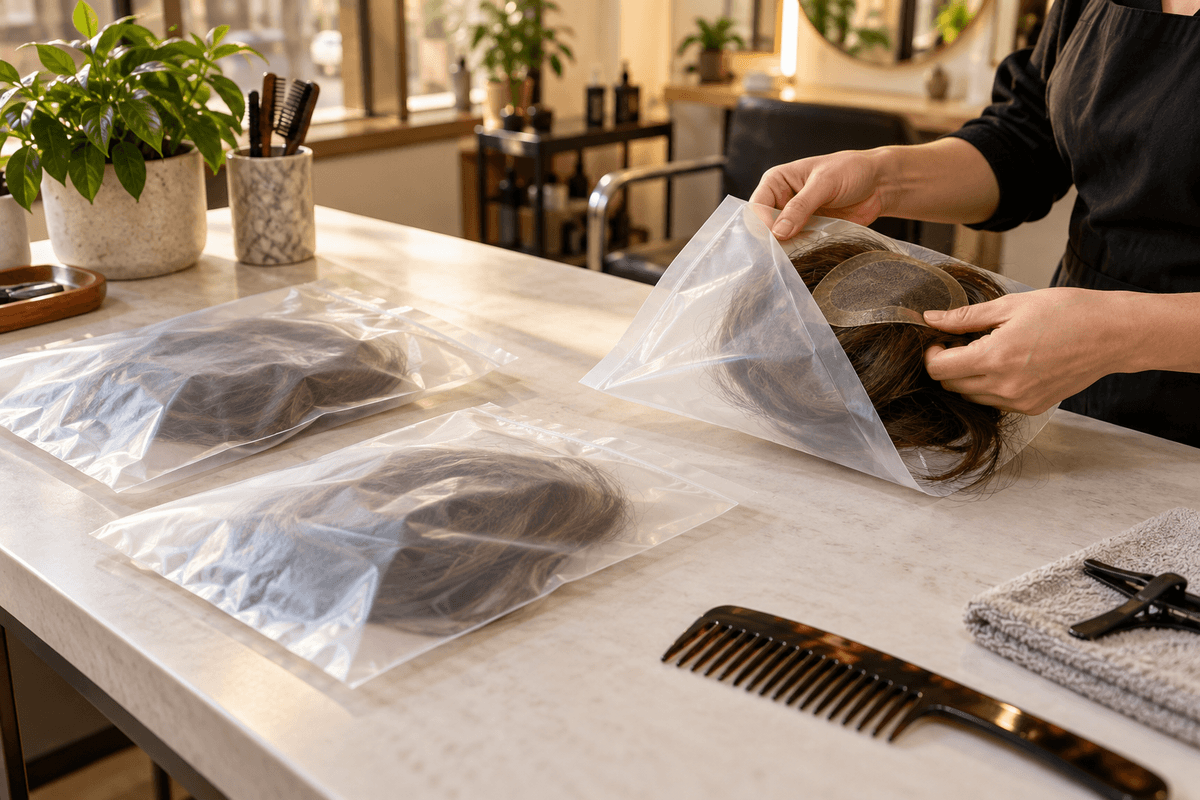
Choose a small number of relevant pieces and inspect them with the same routine. Check the model identifiers before opening packaging. Photograph the received shades under consistent light, compare measurements, and inspect the construction without pulling at knots or stretching the cap.
Evaluate the complete finished item. Does the hair fall into the expected shape? Can you identify the front and attachment points easily? Are the ends appropriate for the advertised style? Does the cap sit as expected when assessed against the stated measurements?
Test any permitted washing and restyling only after you understand the return conditions. Keep an untouched reference sample when practical. Your records should distinguish a defect at delivery from a change following salon customization.
Do not convert a successful pilot into an unconditional promise that every piece will last a fixed number of years. Wear, maintenance, processing, and construction all affect performance. Sell the features you can explain and support with care guidance.
Use Comfy Wigs to compare specific finished products
For a human hair topper category, begin with the Human Hair Topper FK008. The listing identifies human hair; your next questions should concern the base dimensions, attachment method, shade choices, and the kind of top coverage it provides. A wholesale discussion should identify the exact model and requested quantity.
Include the Human Hair Topper FK011 in a second sample brief if you want to compare another topper model. Ask Comfy Wigs to explain the construction differences rather than guessing from the names. Record those answers alongside the samples so staff can recommend them consistently.
The Human Hair Topper FK014 is another human hair topper option to discuss. Treat its suitability as a fitting decision, not evidence that your full-wig specification has been met. Confirm the features that matter to your clients before considering inventory depth.
If your range also includes blended finished wigs, the Classical Black Curly Human Hair Blend Wig YWLH-14 belongs in a separate category. Its product name identifies a human hair blend. Keep that description visible in your purchasing and customer-facing records rather than placing it in a 100% human hair assortment.
These links make Comfy Wigs a concrete supplier to approach for finished-piece quotations. They do not establish a particular wholesale discount, minimum quantity, raw-hair origin, or production schedule. Get those commercial terms in a current written quote.
Price the stock you can actually sell
Compare the full acquisition cost: product price, delivery, applicable import charges, packaging, and any customization you are commissioning. Add the practical costs of inspection, fitting, and aftercare to your internal decision. A cheaper unit is not better value if it repeatedly requires work your staff cannot recover.
Use a simple scenario rather than an optimistic forecast. Suppose one option requires extra consultation and another arrives in the intended shape. Compare the time and service each needs, using your own figures. This is an internal buying exercise, not a claim about guaranteed margins.
Ask whether different shades or models can be combined in an order and whether that affects the quoted terms. Clarify how partial shipments are handled. A discount tied to slow-selling colors can leave you with inventory that looks inexpensive on paper but does not fit your clientele.
Plan the second order while evaluating the first
Confirm how the supplier will identify the same model on a reorder. Ask what notice you receive if a cap, color option, or construction changes. Keep a written rule that substitutions need approval before dispatch.
Also establish who handles product questions and what information they need for a claim. Model code, clear photographs, date received, and a description of the discrepancy make a problem easier to investigate. Avoid altering a disputed piece before the supplier has explained the next step.
For the first commercial purchase, choose a range you can fit, explain, and maintain well. Approach Comfy Wigs with the shortlisted models and a precise sample brief. Once the pieces and service meet your criteria, expand based on observed demand rather than a broad promise of “premium wholesale quality.”